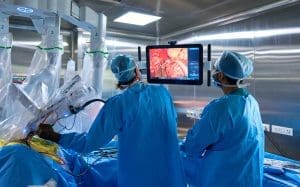
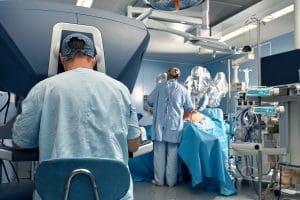
St Bernard’s Hospital has shown that geography does not have to limit surgical ambition. Its robotic programme demonstrates what can be achieved when clinical leadership, careful preparation and the right technology partners come together.
Launching a robotic surgery programme is a significant undertaking for any hospital. Doing so at St Bernard’s Hospital in Gibraltar, where distance and logistics add another layer of complexity, is a particularly notable achievement.
The Gibraltar Health Authority has moved from ambition to live robotic surgery, establishing local capability at the territory’s only public hospital. The programme has since progressed to a landmark in remote surgery Professor Prokar Dasgupta, who leads The London Clinic’s Robotic Centre of Excellence, performed a prostatectomy performed on a patient in Gibraltar while the surgeon operated from London, around 2,400 kilometres away.
That milestone rightly belongs to the clinical, theatre, technical and leadership teams in Gibraltar. It reflects their willingness to adopt new technology, build new ways of working and create a safe, resilient service in a location where specialist support and supply chains cannot always be taken for granted.
A ROBOTIC PROGRAMME IS MORE THAN THE ROBOT
The robotic platform is the most visible part of a programme, but it is only one part of the operating environment. The robot does not automatically provide every device, workflow or practical solution needed to deliver a safe and efficient procedure.
Before the first case, teams must consider insufflation, patient positioning, pressure-area protection, access to the patient, theatre layout, consumables, smoke management, equipment compatibility, staff training and case-day workflow. Each decision may appear ancillary to the robot itself, but together they determine how smoothly the service functions.
For a centre introducing robotic surgery for the first time, these details can be difficult to anticipate. They often sit across several professional groups and may fall outside the scope of the robotic system supplier. This is where a broader, consultative partner can add practical value.
Supporting everything around the platform…
“What Lawmed did is get rid of some of the headaches in the background…” – Mr. Andrew Gordon
Lawmed worked with Andrew Gordon, Colorectal Surgeon, Hamish Thomson, Consultant Anaesthetist and the wider St Bernard’s team to help identify and address requirements around the robotic platform. The support extended beyond product supply, drawing on experience from established UK robotic centres to help the team consider positioning, workflow and the ancillary equipment needed for reliable case delivery.
AirSeal formed a central part of that support. In robotic surgery, maintaining a stable pneumoperitoneum while instruments move through the abdominal wall is an important practical requirement. AirSeal provides valveless access, stable pressure control and integrated smoke evacuation, helping the theatre team maintain the operative environment throughout the procedure.
“The AirSeal system is absolutely fantastic for robotics, achieving nice low pressures during the case with good visualisation, low fogging.” – Dr. Hamish Thomson
Patient positioning was another key consideration. Robotic procedures can involve prolonged periods in a fixed or steep position, while access to the patient becomes more restricted once the robot is docked. PrimaPad was introduced as part of a wider positioning approach designed to support patient stability and pressure-area protection throughout the case.
“PrimaPads had been a game changer for us.” – Dr. Hamish Thomson
The value of this approach is not simply in selecting individual products. It is in examining how the products, people and processes work together: where equipment will sit, how the patient will be positioned, what must be available before docking, how consumables will be managed and what the team will do if the planned workflow changes.
Robot-agnostic support
Lawmed’s role is deliberately robot-agnostic. Hospitals may select different platforms according to clinical need, procurement strategy and local priorities, but the challenge of building the environment around the robot remains.
A broad minimally invasive surgery portfolio allows Lawmed to look beyond one device or manufacturer. The aim is to help hospitals build a coherent pathway around their chosen platform, combining products with practical implementation support and experience of how robotic services operate in real theatres.
That independence is particularly valuable for a robotically naive centre. Rather than expecting the hospital to discover every requirement case by case, Lawmed can help teams identify gaps earlier, test assumptions and put the supporting infrastructure in place before those gaps affect a live list.
“…embracing a very supportive company like Lawmed with excellent products that they have to offer, and the technical support behind that has been critical to the successful implementation of this programme.” – Mr. Andrew Gordon
DESIGNING FOR RESILIENCE AT A DISTANCE
Gibraltar’s location makes preparation especially important. On the UK mainland, an urgent replacement, an additional consumable or on-site technical support may be comparatively accessible. In Gibraltar, lead times, transport links and stock availability must be considered much earlier.
Supporting a remote programme therefore means designing for resilience as well as performance. Forecasting usage, agreeing appropriate stock levels, standardising set-up and ensuring the theatre team understands the full pathway all reduce avoidable pressure when surgery is under way.
The same principles apply to other hospitals away from major robotic hubs. Distance should shape the implementation plan, but it should not limit the quality or ambition of the service.
From first cases to telesurgery…
The progress at St Bernard’s shows what becomes possible when the foundations are right. The programme began by developing local robotic capability and has already supported a major telesurgery milestone connecting Gibraltar and London. Professor Dasgupta operated from The London Clinic, supported throughout by The London Clinic’s own clinical and technical team, with urological surgeons joining the on-site team caring for the patient at St Bernard’s Hospital.
Telesurgery naturally draws attention to the network, console and robotic platform. Yet a remote surgeon still depends on the team and environment around the patient: the Gibraltar case depended as much on the on-site clinical team at St Bernard’s as it did on Professor Dasgupta and The London Clinic’s team at the console. The surgical environment must remain stable, positioning must be secure, equipment must be available and the on-site team must be ready to respond. The further the operating model develops, the more important that surrounding system becomes.
For Lawmed, supporting Gibraltar has reinforced a simple principle: successful robotic surgery is not created by installing a robot alone. It is created by aligning technology, people, products and workflow around the needs of the patient and the clinical team.
A MODEL FOR AMBITIOUS ROBOTIC CENTRES
St Bernard’s Hospital has demonstrated what determined clinical leadership can achieve in a geographically remote setting. Its team has not simply adopted a new platform. It has built a functioning robotic service, delivered live cases and contributed to the development of long-distance robotic surgery.
Lawmed is proud to have supported the environment around that achievement. Through AirSeal, PrimaPad, a broad minimally invasive surgery portfolio and practical, robot-agnostic consultancy, Lawmed can help hospitals anticipate what sits beyond the platform and move towards first case with greater confidence.
Whether a programme is being established in a large mainland trust or a remote hospital, the objective is the same: a safe, efficient and sustainable robotic service in which everything around the robot is ready to perform.
“…given us totally cost-neutral solutions without trying to sell us anything… Lawmed have been with us every step of the way. I don’t think it is a good idea to try and implement a robotic programme in a robotic centre without getting hold of Lawmed right at the start.” – Dr. Hamish Thomson
Planning a robotic programme?
Lawmed can help assess the ancillary products, positioning requirements and theatre workflows needed around your chosen robotic platform. Contact the Lawmed team to discuss your programme.